While the gang ponders the impact of Merchants of Doubt, the movie, I have drifted back to my questions about "global" latent heat flux. There is considerable differences between the different latent heat flux products. In the beginning, back in the day of the younger James Hansen, data was crude at best. Kiehl and Trenberth produced a series of Earth Energy Budgets that attempted to get all the pertinent information down in an easy to read format.
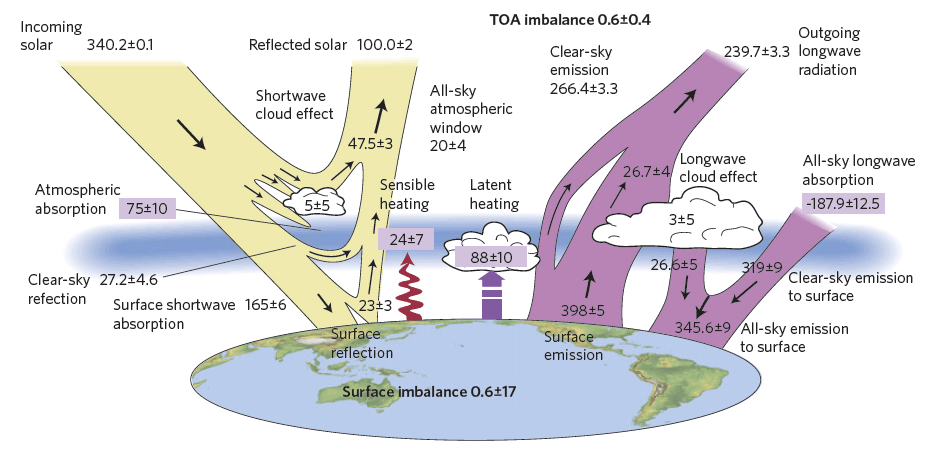
If you have followed my ramblings you know that I discovered an error in these budgets along with a number of others, but it was Stephens et al. that final published a revised budget a couple of years ago.
This budget was discussed on Climate Etc. back in 2012. Stephens et al. have latent at 88 Wm-2 +/-10 Wm-2 with K&T likely being the minus 10 and Chou et al likely the plus 10. The other major difference is the atmospheric window where Stephens et al have about 20 +/- 4 and K&T in their latest are still using the 40 Wm-2 with no indication of uncertainty.
This post was prompted by Monckton of Benchley mentioning the Planck Feedback parameter he derived using the K&T budget. That was based on the paper, On the confusion of Planck feedback parameters, by Kyoji Kimoto. At the time I mentioned that Monckton and Kimoto were off because they used the inaccurate K&T budget, but that was prior to a real scientist publishing a revised budget.
Climate science appears to be finally catching up, but various irreducibly simple models never finish connecting the dots. Tropical water vapor, clouds and convection are the most likely candidates for the regulating feedback. Around 98 Wm-2 of latent you peg the negative feedback portion of the regulating feedback triggering deep convection. If you initially assume that latent is 78 Wm-2, one of the initial estimates used by K&T, you have a large range of positive feedback from 78 to 98 or 20 Wm-2 which is about half of the atmospheric window assumed by K&T. Since an absolute temperature has been a wild assed guess at best along with latent and convective energy flux, the room for warming has always been over estimated.
Andy Lacis on Climate Ect. mentioned they project a 28% increase in atmospheric water vapor which would roughly be equivalent to a 28% increase in latent heat flux. A 28% increase from 78 Wm-2 would be 99.8 Wm-2 which we are roughly at now if Chou et al had an accurate estimate back in 2004.
The followers of the Merchant of Doubt drivel seem to believe anytime someone mentions uncertainty they are clouding the issue, but when all uncertainties tend to lead to the highest possible estimate, that is a simple sign of bias. You do not have to be a rocket or atmospheric scientist to be aware of sensitivity of error. In climate science the old guard are doggedly defending estimates based on extremely poor data while ignoring prompting by peers that they are off. With accurate latent estimates Earth's Energy Budget is at the elusive Planck Feedback limit.
That does not mean there is not going to be some residual warming at the poles, but most of that will likely be in winter related to energy release mechanisms like Sudden Stratospheric Warming (SSW) and Arctic Winter Warming (AWW) related to increased pole ward "wall" energy flux.
The key to "proving" as in providing convincing evidence, are more accurate estimates of latent heat flux and convective response. The newest Stephens et al paper, also discussed on Climate Etc. appears to have part of that evidence.
It indicates that the northern hemisphere is releasing energy while more is being provided by the southern hemisphere via ocean currents. Unfortunately, they may not have the estimate of northern hemisphere heat loss to space associated with SSW and AWW events correct. That may require a more creative non-linear approach likely Fluctuation Dissipation Analysis, but really could be estimated with surface energy anomaly and high northern latitude ocean heat uptake. Basically, northern high latitude SST has increased while ocean heat uptake has flat lined above 50 north. That difference after considering uncertainty, should be heat loss not easily measured by satellite at the pole. That loss can be on the order of 10^22 Joules in a single season.
The northern hemisphere heat loss may or may not trigger a negative AMO phase, which would make the shift obvious or it may just continue destabilizing the north polar jet/vortex until some glacial increase begins to store the energy. Greenland is beginning to show signs of accumulation, but that may take a decade to be "noticed" given the current state of climate science. Then again that loss could trigger an ice mass loss event, such is long term climate.
In any case, perhaps the current buzz will inspire some to revisit the much maligned, On the Confusion of Planck Feedback Parameters with more up to date observations.
New Computer Fund
Tuesday, March 17, 2015
Monday, March 16, 2015
Zero tolerance in a complex world
Particulate Matter 2.5 micron or PM25 is know to have adverse health effects but PM25 is a generic term for a wide variety of small airborne particles. The most common source of PM25 is the oceans and salt spray. Then you have dust which can include some viruses, molds, fungi and bacteria. Volatile Organic Compounds (VOC) from fossil fuel uses, burning wood, grasses trash etc Cigarette and other tobacco smoke, marijuana and any other type of recreational combustion including incense. Pollen, tree saps, flowers any thing that has a scent pleasurable or other wide is releasing VOCs. Smog is almost always caused by man made sources, vehicle exhaust, fireplaces or wood/coal stoves, industrial combustion. Mixed in the the PM25 is often PM10 or 10 micron particulates and occasional larger sizes if you are close to the source.
Some PM25 is obviously bad whether the source in natural or man made and some not so bad with some down right desirable. Desirable and not so bad depends on the individual or group of individuals being exposed to the aroma. I personally think some colognes and perfumes should be banned. The EPA also noted that there is a point of no gain. People with hyper sensitivities will continue to be hyper sensitive.
With PM25, too much is bad, but what is too much subjective. If you attempt a zero tolerance policy, you will never get there. In fact, the more you reduce one type of PM25 the more another type becomes "noticeable".
In the US and other "developed" countries, clean air and water acts have worked to reduce particulate matter in the air where the sources are vehicles and industrial combustion sources. Industrial combustion sources would be power plants for electrical generation and manufacturing processes like concrete, Central electric power replacing coal and wood as home heating and cooking energy reduced the majority of urban air pollution followed by passenger vehicle emission standards.
As Urban living expanded into suburban sprawl, more limits were placed on central power plants for industry and electrical power. Even with Coal as a power source, emissions were reduced with scrubbers and precipitators greatly improving air quality. Changing farm practices, starting after the US dust bowl, have also helped reduce PM in the air.
However, the US and industrial nations are not in this world alone. Emerging economies are going through the same growing pains and will need to improve their own emissions standards.
This produces the conundrum, how clean is clean or what tolerances are most beneficial and cost effective. Technology exists to make any form of fuel source cleaner and more efficient but never perfectly clean or efficient. The closer to zero tolerance regulations shoot for the more expensive basic energy needs become. With PM25 the problem is exacerbated by the diverse natural sources of "pollution".
Living on the edge of the tropics, one of the primary sources of harmful PM is the Saharan Desert and the entire middle eastern desert regions. Caribbean asthma cases are directly linked to African dust along with coral reef damage due to fungi, molds, bacteria and viruses non native to the region killing off key species that help keep the reef system clean. Sea urchins feed on algae that compete with coral polyps. There was a massive die off of sea urchins due to Saharan Dust. Along with the coral, sea fans were also impacted weakening the entire reef ecosystem. In a weakened state, any number of other factors can appear to be a "cause" of reef die off, when a mutation of a fungi variety found in African soils was the initial most likely "cause".
It isn't just African dust. The Island of Barbados top soil is almost completely composed of African dust. African dust has been brought to the Caribbean as long as there have been African deserts and trade winds. The die off could be due to a combination of microbe evolution, land misuse in Africa and changing weather patterns. The rough year of the demise of sea urchins was 1983 for those looking for a climate change connection.
Wikipedia has an interesting animation of particulate matter migration around the globe. the sulfates in white are obvious over China, red/orange is dust located mainly in desert regions, Blue is the relatively benign salt spray, but energy salt spray can carry microbes, and green is black and organic carbon produced by any type of fuel combustion which appears to be mainly biomass burning related to agricultural and underdeveloped nations using biomass for basic fuel.
With developed nations still using fossil fuels including coal, current technology appears to be ahead of the pollution curve. Similar cleaner central energy and more eco-friendly agriculture would appear to have a larger potential to reduce man made particulates and reduce "natural" particulates than extreme regulation of fossil fuels. Especially when the poorest nations in the world appear to be producing the vast majority of air pollution via land use.misuse.
The minions of the Great and Powerful Carbon tend to side step this reality with their carbon causes everything bad simplistic reasoning. Taking fossil fuel use to zero is unlikely to reduce PM25 by more than 30% and less than 10% of the outdated or unregulated uses likely produce the majority of the emissions. It would seem having the rest of the world emulate the developed world's modest measures to reduce air pollution would be much more effective and much less costly. That has a snowball's chance in Hell of happening with the minions running loose though. They have a, ban coal first then sort out the rest, playbook. To most engineers coal is just a resource with advantages and disadvantages, just like nuclear, oil, gas, solar, wind and biomass. It isn't good to be overly reliant on any one or totally opposed to any one. Finding the proper mix for a situation is the goal.
Eliminating any energy option isn't particularly intelligent, especially when it is tied to a global issue that could be mainly natural or at least, the majority isn't related to that energy option.
So what are the risks associated with outdoor pollution? According to this Cancer Research UK article pretty small but there is definite link between outdoor pollution and lung cancer. If you smoke you are about 20 times more likely to develop lung cancer and some studies put a 22% increase in risk per multiples of 10 micron exposure. 15 microns/cubic meter was considered the upper limit in the US for "clean" air but there was a move to regulate at 12 microns per cubic meter. So if you live into your fifth decade you have a risk of lung cancer. As you live longer your risk of other causes increase so your lung cancer risk decreases. The longer you live the greater your chances of dying from something which I am sure must come as a surprise to many.
With lung cancer being a fifth decade typical onset disease, the developed world clean air acts being roughly 40 years old and people transitioning from "dirtier" manufacturing and construction trades to "cleaner" service related industries, there are plenty confounding factors to be dealt with in determining how significant a problem PM25 really is. Cleaner air though would be better, but since the current air quality is just marginally significant as a carcinogen, maintaining the status quo of incremental, cost effective progress towards better air quality seems more rational than drastic changes that could produce unintended consequences.
Dramatic, note the root drama, change is very progressive though. There is no problem so small it doesn't deserve our immediate attention. With anarchists who do not wish to be governed setting out to become the governors, it should be obvious there will be plenty of piggyback political baggage involved in all the progressive initiatives to save the world. It is impossible to make everyone happy, but the progressive haven't come to grips with that basic reality. It is good for them though since there will always be some cause to occupy their idle musings.
In the real world, you do the best you can in a way that doesn't break the bank and you leave your options open.
For another opinion on air pollution consider the real issue, indoor air pollution. Bjorn Lomborg has a article in Forbes that is right on target. With a third of the world population still cooking over open flames be the energy source dung, coal or wood and developed nations enjoying tightly constructed central air condition dwellings, indoor pollutants are the real killer other that urban areas in rapidly developing countries that haven't addressed clean air regulation adequately. Since this problem doesn't mesh with the carbon issue, it is not getting attention it deserves. Centralized power generation and rudimentary electrification even using demon coal as a fuel source would reduce the third world problem while more timely maintenance and a bit of bleach would do wonders in the developed world.
In the developed world, water plus dirt produces molds. Drywall is dirt sandwiched between paper with makes great mold growing habitats when you add water. Dirt in air conditioning systems with their dark, moist interiors can produce wonderful mold science projects. So all the while scientists study the impacts of outdoor particulate matter their subjects can be getting much more at home.
Real science needs to deal with the confounding factors before condemning progress in the name of progressive-ism. As it is, they are coming up with too many solutions for the wrong problems.
Monday, March 9, 2015
Circumstantial Evidence of Secular Trend
I was playing with so simple linear regressions more to aggravate some of the minions than to really accomplish anything. I am pretty positive there is a fairly larger range of undecipherable climate noise. Some might call it chaos, but any simple control system has a range around a set point. If you want to reduce that range you are looking at big bucks and potential instability. It is simpler and more cost effective to "live" with a reasonable amount of fluctuation unless you have a very temperamental process. Having worked with "novel" new control schemes like PDI feed forward, I have witness some spectacular initial failures. Most of these types of control systems are viable now with more and faster computing power, but for simple things like HVAC control at the time they were a huge waste of money. The average person cannot sense a temperature change of less than 2 F and there is no "ideal" temperature range for all people so a half degree to degree of "slop" for indoor air temperature control is perfectly acceptable. Even a larger range of humidity control is acceptable and with proper system sizing, pretty much takes care of itself.
There are cases where more precision is required and the cost is justified, but proper load sizing as staging can reduced the complexity required for even those cases. Simple isn't a bad thing.
What I did just for grins is a simple linear regression of GISS global with and uncertainty channel. I just eyeballed the fit and was pretty happy with 0.5 C which happens to be 1.6 sigma for the GISS monthly data.
A little light smoothing, 13 month moving average, provides a one sigma, 0.29 C eyeball fit. Since only five years of the 134 years total make it outside the channel, that is about a 95% uncertainty range in spite of the one sigma notation which implies about 68% uncertainty. So in my opinion, with about a 0.3 C range global climate is pretty stable. You can get the same fit with climate model runs with about +/- 0.35 C, mainly because of the volcanic forcing misses. Smooth those out and you can get a more respectable error range for the high dollar estimates.
I then spliced the global with the Oppo et al. 2009 reconstruction, but had to kick the range back up to 1.6 sigma to get a fit back to about 1780. After throwing in a pre-Little ice Age error range of +/- 0.29 C, I have a basic model of expected climate. The difference in the slope of the dark green LIA recovery and the blue instrumental is roughly "potential" Anthropogenic Climate Change. If you used the green regression and added CO2 forcing with a 0.8C "sensitivity" you could fit the two curve pretty well. Of course, the Oppo 2009 and instrumental have different smoothing and picking the slope of LIA recovery is a bit of a guess, but it is in the ball park.
Since I am fairly certain that tropical convection and cloud cover trigger around 28C to produce significant negative feedback, the intersect of the linear regression and pre-LIA range are a pretty good illustration of what I expect climate to do. That would be crab sideways with a fluctuation of around +/-0.5 C degrees. So this is my prediction of the month.
If you are an ENSO fan, the projection would be 26.9 C +/- 0.5 C degrees. Since some believe that ENSO, PDO and AMO are the sources of all variability, that might make them happy. Personally, for global climate I would watch the tropics in general not any region in particular. I have done a number of correlations between various tropical bands and "global" temperatures and the 30S-30N band is in the 70% and 80% range since it has over 50% of the total ocean area.
I haven't figured out a real "sciency" way to fit the sea level rise into the picture, but roughly matching instrumental, SLR and Oppo 2009 looks like this. Since there is more than just thermal expansion involved with SLR, a convincing fit with rational error bars will be quite a challenge. I do have some thoughts on the subject, but that will take some real work which is against my current religion.
So there is the title of the post, "circumstantial" evidence of a secular trend related to LIA recovery.
Subscribe to:
Posts (Atom)


